
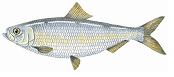
The historical record is clear: herring once made annual migrations up the Stroudwater River to spawn. But which kind?
If you read the news, you probably know that the Atlantic herring fishery is experiencing disaster-level instability due to over fishing. Atlantic herring spend their entire life cycle in the ocean, but their closely related cousins, river herring, are anadromous, meaning they are born in freshwater, live most of their adult lives at sea, and return to rivers, ponds, and lakes to spawn.
There are two types of herring native to Maine rivers: alewives and bluebacks. Both species likely ran up the Stroudwater before it was dammed in the 1850s. The two fish look very similar, but alewives have a greenish tint, while the bluebacks get their name from a dark blue band along the top of the fish. No commercial distinction is made between them: both are harvested as food and as baitfish, though alewives are more plentiful.
It is their spawning habits that set them apart. In Maine, Alewives spawn in early to mid May, in still water, such as ponds and lakes. Bluebacks prefer to deposit their eggs in swifter stream currents, about a month later. The species may have co-evolved so as to not compete with one another for spawning grounds.
Herring was a crucial food source for native communities. The Wabanaki traveled seasonally to harvest herring at the mouths of rivers, including the Stroudwater, where the Spring spawn presented an opportunity for netting the fish. Herring that was not eaten fresh at the net fishing encampments, or used to enrich the soil of gardens, was dried or smoked for later consumption.
In the eighteenth and nineteenth centuries, dams for the generation of mill power were built on Maine rivers large and small, reducing or eliminating access to herring spawning grounds. Herring that once returned in the millions were turned away, creating a crisis of survival for the Wabanaki, sparking conflicts with locals, and prompting Native leaders to petition the seat of colonial government in Boston to restore fish passages around the dams.
Herring are the most abundant fish on earth and are considered to be the most commercially important fish in history. Cities have been founded and wars have been fought over the “silver of the sea.” In 2006, alewives and bluebacks were designated a species of concern by NOAA. Dam removals on the nearby Premsumpscot River have been successful in bringing these fish back. Maybe it is time we welcomed these intrepid travelers back to the Stroudwater.
Fisheries Then: Alewives and Blueback Herring, 2014, Beaty, J.
Maine River Herring Fact Sheet, Maine Department of Marine Resources
This Was Stroudwater, 1727-1860, Lovejoy, M
Species of Concern: Alewives and Blueback Herring, NOAA National Marine Fisheries Service
 Friends of the Stroudwater River